0
Posted on 3:11 PM by 4 8 15 16 23 42 and filed under ,

Have you ever wondered, where does the word “Bluetooth” come from? Honestly, I haven’t until a few days ago. Though, in an art class at college, I learnt why they named this wireless connectivity technology, Bluetooth, and I think it’s pretty interesting.
Harald Blåtand or Harold the Bluetooth (935-986), was the king of Denmark from around 958, and he is best known for his unification of Denmark and Norway.
Ericsson, a Scandinavian company, was the first to develop the bluetooth specification. Also Nokia has been researching on this technology also.Along with other 3 major companies In Feb 1998, Ericsson, Nokia, IBM, Toshiba and Intel formed a Special Interest Group (SIG). As the role of Scandinavian technology was higher on the developpement of such technology, came up with this name because this technology was ment to unite the world, as in a sense did Harold Blåtand for Scandinavia. So this name fit wery well to Sweden based Ericsson and Finland based Nokia.
Had Harold I of Denmark a bluetooth?
No, the name "Blåtand" was probably taken from two old Danish words, 'blå' meaning dark skinned and 'tan' meaning great man. But in english it means bluetooth. So the king had nothing to do with a blue tooth.
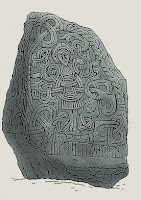
Why I studied this in an art class? Harold the Bluetooth, who also christianized the country, raised Jelling Stones which present the process of christianization. The stone has a figure of Christ on one side and on another side a serpent wrapped around a lion. Apparently, this stone is one of earliest marks of christian symbology. It is important as the early symbology had only 2 dimensions and afterwords it gained perspective and detailed descriptive narrations.

0
Posted on 8:37 AM by 4 8 15 16 23 42 and filed under
Recent news about the Nobel Peace Prize that Barrack Obama received, makes me wonder what about the other candidates.

Nobel Prize Medal
So, Who were other candidates?

Appereantly there were more than 200 candidates, though a few of them were considered very strong. These are:

Denis Mukwege: A doctor who has devoted his life to helping Congolese victims of sexual violence.

Sima Samar: A Afghan women’s rights activist who kept her schools―the only high schools in the whole country girls were able to attend―open under the Taliban regime.

Ghazi bin Muhammad: Prince of Jordan who brought prominent Islamic scholars together to work out a "theological counter-attack" against terrorism.

But, they didn't get one. Obama did.

Why did he get it?

Official Press Release of Nobel says:
“Only very rarely has a person to the same extent as Obama captured the world's attention and given its people hope for a better future. His diplomacy is founded in the concept that those who are to lead the world must do so on the basis of values and attitudes that are shared by the majority of the world's population.”


Pretty impressive I think. Obama really gives hope to many people around the world but giving him a Nobel for that? Unusual.

Nobel academy, obviously has many motivations in givinhg Obama this honor. Though, it's a great risk for the prestige of this award. Isn't this award based on prestige, for 100 years?

If Obama really succeeds in solving some of the major political conflicts, then ok, nobel commitee would have lost anything. But what if Obama does't manage to fullfill his committements to Americans and to the World, and fails? Wouldn't it damage Nobel?

Peace category is different from scientific and literary categories, though it is very important in drawing th world's attention. The recipients are more popular, therefore arguable. 1994 prize given to Yasser Arafat; Peres and Rabin also had raised questions like the Obama prize, and there were ciritics that although nothing concrete has accomplished, they were awarded a Nobel.

After going through the list of Nobel laureates, for the peace award, i guess, for the real popular ones they're saying : “It would be good if you have accomplished something, if not don't worry, if you try you will get one!”

I've read articles proposing a Re-Evaluation of the prize, because it has lost its meaning. All I know, if I were a Nobel price winner with my achievements, I would very upset:)


0
Posted on 11:58 AM by 4 8 15 16 23 42 and filed under


Think of the discovery of America. After the discovery of Marco Polo, Spaniards have decided to come to South America with their forces. One key event on the colonization of America was the collision between the commander Pizarro who served Spanish empire and Atthuallpa, the Inca emperor believed to be son of God by the Incas.

After couple of interactions between White European and Native Americans, emperor Attahuallpa agrees a visit by commander Pizarro in the capital of Inca Empire, Cajamarca, on November 16,1532.

The commander Pizarro had almost 160 men along with a bishop and couple of close commanders. On the other hand, emperor Atthaualpa, had 80000 soldiers who knew the land, along with him.

Think of the contrast between two forces, Spaniards were fewer than 1/500 th of Incas, they were on a different continent, different climate, and in deep fear because of their insecure position. Incas had obviously more infantry, they were anxious possibly because of the men in front of them looked different than them, but given the imbalance between forces , the Incas were not in panic.

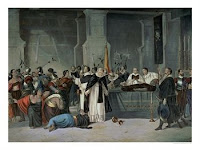
When Spaniards arrived at Cajamarca, they were already waited by Attahualpa. Pizarro and the Spaniard bishop, came near Attahuallpa to communicate. Bishop, gave Attahuallpa a Bible, to which he said, Attahuallpa and his people should obey from now on. Attahuallpa after looking at it for a couple of seconds, throws it to the ground, and refuses to obey it. Bishop, shocked by the gesture of Attahuallpa, tells Pizarro to attack them and by any means convert them to the Christian Path. Pizarro gives a signal of attack to his forces, 100 men with limited horses and guns.

What would be the outcome of this war? Incas would have killed Pizarro and his forces, maybe left some of them alive, let them turn back to Spain and tell the Spanish never to send forces again. That would be the most logical case maybe.

But, what happened instead? Forces of Pizarro, on top of horses, have killed that afternoon almost 7000 Incas, while they didn’t lose much people( if night hadn. Pizarro, kidnapped Emperor Attahuallpa and took gold worth a fortune.

How come that happened?


There were couple of reasons of the success of Pizarro,
First of all, Incas never saw any horses on their entire life. Horse would be the biggest mammal that those Incas saw that day. That is a huge advantage, because fighting over a horse gives Spaniards protection, on the other hand it was easy for them to attack Incas when they were desperately running from them.

The second major advantage of Pizarro is that he brought a group of bando with him. When he gave his signal of attack, the band started to create sounds forceful as they can, and attracted their attention while horseman infantry attacked from the other direction. Incas never were exposed to such a high decibel of volume, so they got panicked when they heard such a noise.

At the end of the battle, Incas were defeated in their own territory, lost almost 8000 forces, lost treasures, humiliated, panicked and lost their emperor.
Pizarro then bargained Incas for their emperor in exchange of information and gold, obtained all he wanted but killed Attahuallpa instead of releasing him. In Incas, hierarchical order was gathered at one man Attahuallpa, and also religious order. When he was murdered, the hierarchical order of Incas collapsed. How could, the Son of God could, would be murdered by white man with giant animals and tools they have never seen before?

So why didn’t Incas have horses to fight back anyway? Why didn’t they stop Spaniard invasions with their naval power?

And most of all, why weren’t the Incas, themselves instead, were the ones who discovered Europe, killed thousands of Spanish and kidnapped the Spanish Emperor?

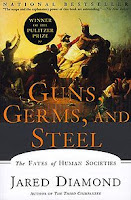
This was indeed the main starting point of the book I recently read, Guns&Germs&Steel. It is not as easy to read as Harry Potter but it was not hard for me to read at all. The author, Jared Diamond gives this Pizarro – Attahuallpa battle in order to attire reader’s attention. It sure does!

While I was reading the book, I discovered that I have never thought about the subject before. I’m sure %99 percent of my friends haven’t also. The great thing about the book, you learn why the history happened that way, instead of what happened. He uses known examples of New Guinea and Australian tribes in explaining and his arguments and he thereby proves his examples.

I would really recommend you to read the book, though reading a book like this need concentration and time. Now I’m going to try to resume his major arguments on why some continents were more advanced than the others.

His major point of all, is that there is no racial cause such as Europeans were more intelligent than Native Americans, but instead all the levels of civilization of continents individually, depend on geographical differences. So if 40000 years ago, if some magical force replaced Native Australians with Europeans, it would still be the Europeans who discovered and conquered Australia, not vice-versa.

1)Availability of Domesticable Plants and Domesticable Animals

We all know that throughout the history, settled-farmer communities were the ones who reached to a much higher civilization level, not the hunter-gatherers. But hunter-gatherers were not hunter-gatherers by their choices, they were obliged to , in order to survive in their geological constraints. The change for societies from Hunter-Gatherers to Settled Farmers, do not occur on one day, they pass through a long transition period. And they only decide to change their lifestyles(hunter-gatherer/settled farmers) when they have adequate sources.
Sources in this case, are usable (eatable) plants and also protein-rich animals. A concept “Domesticability” is very important here. For the plants, it means that the plant is becoming more productive over generations and gives product useful to humans.
On the other hand, a Domesticable animal means an animal which adapts over generations to be kept under human control, abandons its wildness, from birth to death. Cows, dogs, cattle, horses are examples of domesticated animals. Cheetahs, zebras, elephants are not.
One remark about Domesticable animals, that there are animals that are not domesticated but tamed; such as elephants in India. They were kept in cages and used in wars etc. but they never adapted themselves to human control and therefore never domesticated.

Some animals and plants can be domesticated, while some cannot. This was a major difference in continents individually. Fertile Crescent, in south west Asia was home to many Domesticable plant and animal species, by 8000 B.C. This was a huge advantage of the region. Consequently, the population of the region changed their lifestyles from hunter gathering to farming and agriculture. So they could reach more easily to the State (Nomads- Tribes- Chiefdom- State) comparing to the other populations in the other continents.
Sumerians, Egyptians, Hittites are examples of such great civilizations.

2)Discovery of Writing

Discovery of writing is an interesting topic. According to Diamond, simple writing forms have occurred individually in 5 different regions of the world: Mesoamerica, like India, Mesopotamia, China, and Egypt . As it is very useful to accumulate and pass information, the discovery of writing bring populations enormous advantages.
What’s really interesting is, on the continent of America, simple writing forms were found only in MesoAmerica and those forms never reached the stage to pass information. Instead, writing was used only for only simple purposes; the lack of interactions between American civilizations, was one of the reasons of this lag.
Diamond explains the different stages of evolution of languages and writing form, though the lack of writing in America, is one of the main reasons of the lack of technology in the continent.

3)Axes of Continents: North South – East West Axis

If we look at the map of the world, we see that continent of America and Africa is oriented from north to south, that means the length of these distances is superior than the length of its east –west axis. Whereas Eurasia is oriented on east-west axis.

So what’s the importance?

Well, a lot. First of all, in the same latitude levels, the climate is similar. What does that give us?
Traveling is easy (Think of the Silk Road which is a path that exist for at least 3000 years). That brings commercial technological exchange between cultures, so what is invented in China can be brought to France, vice-versa. Information is shared and isolation of societies is not possible.
Plus on similar latitude levels, one is to be able to plant same crops. That boosts the agricultural growth. The crops that are found to be initially in Atlantic Europe could be brought to India for plantation. The same is also true for exchange of Domesticable animals.
In history, that gave the continent Eurasia, a major advantage over the other continents. Australia was isolated with few useful crops and animals; Sahara desert separated the North Africa from south and South Africa was almost isolated from Eurasia; whereas in America the Mexican deserts and extreme changes formed an unsuitable environment for travel and exchange of different crops.


4)Natural Barriers of Continents

It's easy to travel from east to west and from west to east. Whereas when in the north-south direction there are many natural barriers. In Africa there are Sahara Deserts, in America there are Mexican Deserts, in Australia, there are mountains and a very variable climate which isolates the populations within the same continents. These natural barriers prevented human populations to exchange information and to interact.
Very interestingly, 2 of he main American civilizations Incas and Aztecs were not aware of each other.

5)Germs

When 2 different human populations involve in a battle against each other, germs are a major factor on the outcome of the battle. In other words, the diseases that populations have been exposed during centuries, by natural selection, make populations resistant to these microbes, and therefore in the next generations they don't get affected by them. So when 2 populations isolated from each other, physically interact suddenly, they get exposed to different microbes.

This is the case for Australia-European or America-European collisions. Continents had different conditions and therefor their populations had different resistances. But in each case, Europeans had a major advantage. Why?

Diseases generally pass humans from animals. So in order to have the disease, humans and animals should live very closely, and be populous. That means Domestification. Animal domestification was common in Eurasia, whereas America and Australia lacked such animals( or had very little amounts of them). So the more involved European farmers with animals, the more they got diseases, which turned out to be Epidemics. Because of epidemics like Black Death, Europe's population has decreased to its %40. In Egypt, the Black Death killed about 40% of the population. Survivors though, were resistant to these epidemics.

On the other side, in Australia and in America, these epidemics never occurred before the Europeans. They had fewer domesticable plants and animals, therefore have not suffered from epidemics like Eurasians did. So when Europeans come to conquer these continents, they unconsciously brought their germs, which killed more Native Americans or Australians than they did with their guns. Europeans were exposed to local diseases and suffered from them, but recovered quickly.
Before reading this book, I had no idea about the role of germs on the colonization of continents, pretty interesting, huh?


6) Competitively – Innovation

Until the last chapter, Diamond's arguments are mainly on the advantages of Eurasia to others, or the disadvantages of other continents. Well he doesn't very much focus on the interactions between the Eurasia continent itself, only in the last chapter and in the afterword.
Though, in the last chapter, he poses the question “ Why Europe, not China?”
China has a few geographical barriers not preventing, a major empire to dominate the region. China has completed its unification almost 2000 years ago and generally stayed unified since then. Not having a close empire to compete, China lost the technological leadership to Europe. When innovative ideas were discouraged from the leaders of the nations, entrepreneurs had no way to give up. They didn't have any other choice. Though in Europe, the situation was different. When an idea, like sailing ships to India across the ocean, if not funded by Spanish ambassador, could well be funded by Portuguese in order to gain advantage of its European rivals.

Europe contains many geographical barriers, not isolating one society from another, though makes it hard for total control. In other words, human populations in Europe was close enough to interact and pass information, but incapable of dominate of all continent. Accordingly, in Europe many different cultures have evolved and managed to survive. That brought competitivity, innovation and technology.


Finally, I am glad, I read this book who required concentration and time, but gives very interesting and valuable information. Also I am glad that I could finally finish this post which I hope, will be the longest post ever in the blogging history:) Book is very easy to read, and Diamond by repeating same arguments in different chapters makes you really understand it. Though, I was expecting more about “why Atlantic Europe not China” part, though it was just a couple of pages. Maybe I'd read about a book specifically on that question.
After this post, I feel like I've been given some kind of award( because its so long!) Therefore I wanna thank my parents and my friends for supporting me. Also I wanna thank my producer and blah blah:)


P.S: Sorry about my poor writing skills, I may have made many grammatical mistakes, maybe couldn't explain the arguments sufficiently. Well at least the topic is interesting:)
0
Posted on 10:20 AM by 4 8 15 16 23 42 and filed under ,


Well, after months of silence, I decided to continue writing and motivate myself more into it. In these previous mounths, I've been most of the time busy with final projects, graduation stuff, graduation itself, applications, interviews and deciding between possible choices.

Finally, I decided to continue my studies for a masters degree, and on industrial engineering. For me, the main question was not what to study, instead where to study it. I was in between staying in Turkey or to go in France. In the end, I decided to stay in Turkey for at least 2 years.

About writing, I know that keeping a blog updated would be something that I would be proud of myself. The main advantage would be orginazing my thoughts. It's been always good for me to summarize the information that I got from various sources into simple words and it helps me a lot for memorizing.

I was going to restart blogging many moths ago( why did I stop in the first place!) but there was always something that prevented me from doing it./this is another way to say I'm lazy/
I realised that there will always be something that occupies my mind but time is something you make.


And I also decided not to push myself into writing for a while, and write only if I have something to write.

I finish this post by a quote of Al Hirschfeld:
"Everybody is creative, and everybody is talented. I just don't think everybody is disciplined."

I'll need discipline for this blog. Hope I will manage to maintain it. Cheers to non-stop blogging!

0
Posted on 9:01 AM by 4 8 15 16 23 42 and filed under
In this very late post( I thought I had a one post per week rule!) I'm gonna share a short-movie that I've made recently. 

It is my first attempt as video making and I only mixed videos that I took during the day (even the rooster!!), most of them on public transports, ferry etc. 
The great thing about Istanbul is ofcourse the bosphorus and it's always fun to take pictures, videos amazingly you never can stop admiring the view. 

A couple of words on video editing, I searched all the available softwares. Basically I wanted
  • some cool effects
  • video stabilizer
  • something that works quick
  • text adding.... cool effects:)

When I searched down the internet, I saw that there are a lot of blogs that recommend Windows program, Windows Movie Maker. I think it's a cool program but 
  1. slow 
  2. somehow if you give many commands it doesnt respond Error!!!
  3. very limited effects 


Sooo, I decided on Cyberlink PowerDirector. There is a comparison of possible softwares. Here!) For this movie I didn't use many effects but it looks pretty easy. As I said before it's a very very very simple movie, so don't blame me for its stupidness!:) 


Anyway it's fun, enjoy!!
0
Posted on 5:35 AM by 4 8 15 16 23 42 and filed under ,


After the post about Transgenic Plants I couldn’t help but wonder how scientists (or transgenic "artists") can create such species. I took my last biology lesson 4 years ago in high school and I don't remember much about genes etc. So I did a little research about the subject.

While searching over internet, I figured that most of the pages were a little hard to understand for readers with non-biological backgrounds. Yet I found a document prepared by "European Initiative for Biology Education" (EIBE) and it was the simplest to understand. You can check it out by clicking here.

1) First scientists identify what is the gene of interest ( for example GFP gene found in the jellyfish that fluoresces green when exposed to blue light).  

2) They form Recombinant DNA's. A recombinant DNA is, according to Wikipedia, a form of synthetic DNA thereby combining DNA sequences that would not normally occur together. So basically after identifying a gene that is responsible of a certain characteristic, they match the molecules of the chosen Gene with the normal DNA, so that the "Recombinant DNA" carries this foreign gene. 

3) This is the step where they insert the transgene. According to EIBE, there are 3 methods that are used in this step; Microinjection, Use of Retroviral Factors and Embryonic Stem Cell Transfer. 
Microinjection is maybe the simplest to understand. With this method the scientists inject the transgenes with a fine needle, inside of a fertilized cell while a microtube holding the fertilized cell.
The logic is the same as Mendel's discovery with peas (remember it from high school). In every method I suppose, they first inject the transgenic material and try to produce heterozygotes which are the result of a matching of one normal and one modified animal. If they manage to do so, then they match again two heterozygote animals to produce fully transgenic animals. 

Here is a pic, when scientists implemented the growth gene to mice. 

Although genetic experiments are realized mostly on mice, Taiwanese scientists created glowing pigs like the glowing rabbit Alba in 2006 according to BBC. There is even a video of the pigs on the site.


While I was searching all this stuff, a thought crossed to my mind. Think about transgenic humans. Today the genetic engineering has come to a point where a cactus with human hair or glowing rabbits could be easily achieved. So will genetic technology be used to create “better” human beings? Maybe one day secretly, modified humans with different abilities will exist (glowing in the dark wouldn’t be cool thoughJ ). And maybe we will be talking about a new genetically superior generation. Maybe there will be disputes within generations (Mutants vs. Normal People). I never thought these movies could refer to possible scenarios.
But with all these achievements in science, nothing really seems impossible, even Xman.    

1
Posted on 2:47 AM by 4 8 15 16 23 42 and filed under ,


Ok, so in this second( or first) post I want to write about the novel “Next” written by Michael Chrichton.


A few words about the author, he is/was one of the best (for me the best) science fiction writers in the world. He is very well know of the great books he has written such as Sphere, Jurassic Park, Lost World, Disclosure, Rising Sun etc. All of them are masterpieces he also directed well-known TV series“ER”.


The most amazing part of his writing style that he tells you real facts, real scientific events, real discussions and he also presents all this information in a such thrilling story line. His most recent books are “State of Fear” about global warming (I’m starting it tonight) and “Next” about usages of genetic engineering and biotech.


After I’ve read Next, I understood I knew almost nothing about the subject and this book taught me a lot. I mean A LOTT!!

Don’t worry, my intention is not telling you the end of the story I just want to share some real facts from which the author itself got inspired too. 


Transgenic Art

 This is a concept I’ve never heard before. Transgenic Art is defined, according to contemporary artist Eduardo Kac, as

"Transgenic art, I propose, is a new art form based on the use of genetic engineering techniques to transfer synthetic genes to an organism or to transfer natural genetic material from one species into another, to create unique living beings “


So transgenic artists transfer genes from some species to other species and create SHOCKING results. Here are a couple of examples:

  •       Glowing Rabbit Alba (2000)  : Alba is one of the most famous transgenic art  examples of Eduardo Kac. It’s a genetically modified rabbit that “glows” in the dark. Artist took GFP gene that fluorescences green found in jelly fish etc., implemented it on rabbit cells and created “Alba”. 


  •       Cactus that grows human hair(2002) : This example of transgenic art performed by artist Laura Cinti, is a cactus that grows real human hair. She obtained this result by implementing keratin genes in our hair to the cactus genome.


Animals with developed communication skills 


Koko: Koko is gorilla with extensive language capabilities. He can understand more than 2000 English words and 1000 signs based on sign language.


 N’kisi: N’kisi is an African grey parrot with a vocabulary of approximately 950  words. There's an  audio of N'Kisi in conversation with his owner Aimee.    


Apparently Grey Parrots are animals with really special communication capabilities( I wish I  had oneJ ). 

I personally think all this stuff are pretty amazing, and shocking. It’s true that in this era we are faced with different usages of genetic engineering, and biotechnology is one the most important topics of 21st century.


 So actually there are a  lot more in the book, but I don’t wanna cover all the topics. I highly recommend you to read the book and enjoy.