
Showing posts with label featured. Show all posts
Showing posts with label featured. Show all posts
0

From FrozenToothpaste.com
From my point of view, something bugs me. This video cries out “WE ARE IN CRISIS!”, it reminds me this quote from Michael Chricton:

Arda
Since this Blog is about stuff as the title shows( btw I really should consider major changes in this blog. Come on what’s a blog about stuff, how cheesy is thatJ ) , it’s time to dedicate this post to “stuff” itself. Or, maybe to its story.
“The Story about Stuff” is a documentary about the production-consumption and disposal process of every item that we use in our lives. The narrator Annie Leonard, a former Greenpeace employee with a envorinanmental studies degree, is the one who introduces us this story about what goes wrong in our production-consumption cycle and how we can improve it.
Link to: The Story of Stuff

The 20-minute documentary is definetly worth of watching( Animations rule!). Video looks nice persuasive but I wonder if that story is actually the right one?
Actually, there are many critiques to the Story, a quick research in Google and I found interesting results
First, start with the good news. The new school of thinking that Leonard suggest, are mostly accepted without any hesitations. In other words, there’s nothing wrong with “Green Chemistry, Zero Waste, Closed Loop Production, Renewable Energy, Local living Economies”.
Whereas the arguments of Leonard seem to attract more opposite views. For example:
From FrozenToothpaste.com
“Not everything about manufacturing is “toxic.” Make no mistake, I think there are plenty of dangerous chemicals in the things we produce, but you’re playing fast-and-loose with reality if you’re going to say that manufacturing is the simple practice of putting toxic chemicals onto stuff to produce toxic products.”
From Andybrain.com
“ Annie Leonard raised the freak-out level: We dip our pillows in BFR (brominated flame retardants), a horribly toxic man-made chemical, and we sleep on them!
Not knowing anything about BFRs, I did some research on this. I found two things:
One, BFRs are used primarily in electronics and electronics plastics. Things like computer circuit boards, the plastic casing around a TV set, around the rubber sheaths encasing wires in a computer, that kind of thing. And the BFRs are chemically bonded to those components. That means they’re not flying into the air, we’re not breathing them in.
Two, I was unable to find any evidence of companies dipping pillows or pillowcases in BFRs before selling them.”There is even an Alternate Story of Stuff video series. It critiques Story of Stuff, on Youtube.
From my point of view, something bugs me. This video cries out “WE ARE IN CRISIS!”, it reminds me this quote from Michael Chricton:
“The media did not make extensive usage of terms such as crisis, cataclysm,plague or disaster. For example during 1980’s, the word crisis appeared in news reports about as often as the word budget. In addition prior to 1989, adjectives such as dire, unprecedented, dreaded were not common in television reports or newspaper headlines. But then it all changed.
These terms started to become more and more common. The word catastrophe was used five times more often in 1995 than 1985. Its use doubled again by the year 2000. And the stories changed too. There was a heightened emphasis on fear, worry, danger, uncertainty, panic. “

Long word short, media sells catastrophe news and people buy it. That’s the thing that annoys me, I really can’t decide now. Does Anne Leonard really tells us the truth or sells some part of it?
I think the main problem about the Story of Stuff video is that, it lacks detail and explanation. I know, it's a full 20 minutes, but she needed to explain her points more. I guess she tought so, too. As of March 2010 the book of Story about Stuff is available. I hope this time we may really understand the story about stuff.
Arda
0
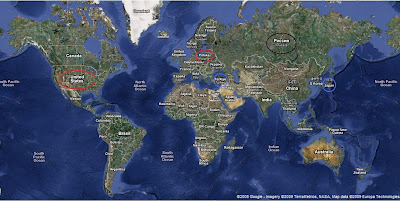
He states that there are cycles of Economic depressions in American history. A crisis, a failed presidency and new system has always been part of the last centuries for us, and it will be similar for the next ones. So around 2030s he expects a great economic crisis for Usa, so for the world ( He doesn’t think that this actual crisis, is a major one!)
Although, I kept on blogging about the books I've read previously, I think it helps to organize the information in my head, and it’s pretty informative. This post is about the most recent book I've read.
Couple of years ago, reading in English was not very easy for me, that's why I was reading easy-reading thrillers. That strategy worked very well for me, I started reading mostly thrillers. These science-fiction, thrillers are generally entertaining, makes your English a lot better, though they are only slightly informative. That's why, nowadays I am more oriented to serious books , difficult to read comparing to thrillers, needs a lot of attention but in the end you end up with very valuable real information.
The title of the George Friedman’s most recent book is interesting, huh? What if we could make assumptions about the future? And what if we were right in our assumptions?
The Next 100 years, deal with this question, only on politics though. The basic assumption of the author is that although future may seem really complex and chaotic thinking all the possibilities, it actually is not. In a simple example, say 2 players are playing chess. Although it seems like player move in many different moves, he cannot, they have fewer moves to play if they think rationally. Similarly, from a political aspect, it may seem like nations or states may go to many directions in the next hundred years, they cannot, they only can move in several directions (if they want their own survival as a nation)
So author states that he can make a prediction, an approximation on how the future will be, and analyzing possible moves of nations, like in a chess game. He adds that it is only a prediction, he doesn’t expect to be right %100 right on them, though if his grandchild’s sees that he was right in some major breakpoints, he would be very glad.
The logic seems reasonable to me. Plus interesting!
The major events that 21.century will observe are:
A crisis in 2020 caused by Russia: Russia vs. Europe &US.
Every war in history happens because of political and economical uncomfortabile situation. World War 1 happened, because Germany and its allies were excluded by the new economic order created by Atlantic Powers. They wanted a bigger share of the economical profits. And they caused a war.
WW2 happened because German nation needed a redefinition. Economically and politically uncomfortable, they caused a war.
In the same context, according to Freidman, Russia who was a world force before the collapse of USRR, wants to regain its power. Eastern Europe and Caucasia are the most important regions for the Russian strategy.
Friedman thinks, Russia will need a redefinition of the region, so a war in 2020s will happen. US will support Poland and Turkey as counterforces to Russia, because they are in great strategic importance and have been US allies for a long time. The war will result by the defeat of Russia and USA will be stronger than ever.
American Crisis: 2030s
2040-2060 World War between Turkey, Poland , Japan and USA
In the Russia against others war, Usa will try to fight the Russians by creating or supporting regional powers. Poland, and Turkey will benefit that, he explains why specifically these countries with historical and geopolitical facts and seems reasonable from a point of view.
On the other hand, he thinks that China will collapse, seen as a potential major power China is actually so dependent to other economies mostly to USA, that it will never have the resources to independent economical aspects. Plus, he emphasizes the cycles of the Chinese history. More clearly, China has always had time periods when the government encourages foreign capital, and after a while another government abandons this strategy and dictatorships rules. I’m not sure if I could explain sufficiently, though the main point according to Friedman is that China will divide and so will not be a world force.
On the other hand, the division of China will strengthen Japan, which is the second largest economy of the world. Despite the fact that Japan is a economically strong country, it is trapped in its boundaries, in a geographical dilemma. It will try to expand his influence and become a stronger force.
/*
The parts about Turkey interest me a lot, since I am a Turk. Though there are many arguments that I don’t agree.
Author emphasizes that Turkey, the successor of the Ottoman Empire, is the most likely candidate to influence the Islamic world and become a regional power. Turkey has a geographical position highly important and can expand to many directions. All these arguments seem reasonable, but the author( who is an American who interprets the news) assumes that Turkey will be on a moderate-Islamic axis. This is the hottest issue, some see this Islamic orientation as a threat to actual modern and secular system, and some see it as a fact that we shouldn’t be worried about. What Friedman suggests seem to me, like Turkey will be an Islamic state in order to increase its influence in the region.
What about Ataturk?
Mustafa Kemal Ataturk was the leader and founder of the Turkish republic. He offered a view oriented towards the west, denying some Islamic hierarchical foundations and built a modern state.
And as I mentioned previously, the current conflict is generated from the possibility of ignoring last century’s work ( i.e. Secular state) and heading towards an Islam oriented state.
I hope it does not happen.
Analyzing current Turkish foreign strategy, Friedman may be right in his conclusions. But I don’t think he takes account the recent history of Turkey and principles of Ataturk’s revolutions. I don’t think Turkey can sacrifice these, in order to influence the Islamic world even Middle and South East Asia.
/*
ANYWAYS, Turkey and Japan will be allies and Poland supported by Usa and Europe will be the enemies. This wear will occur in 2040-2060s and as the technology advances, the war will not be ground-based but mostly-space based. Consequently this war will not result as many deaths as WW2.
Throughout this war, world will face to many technological advances, but space based solar energy will be the one that shapes the future.
War will result by the defeat of Japan and Turkey and this time the real Golden Age of America will begin. Usa which has the power to control the oceans, will this time have the power to control the space.
2080’s Mexico rises again
Today many states in Usa have Hispanic population. In Border States to Usa, like California and Texas the Mexican-American population is already abundant comparing to other ethnical identities. As the demand for labor increases in the next century, Mexican population will continue to augment in the Usa, especially in border states. Texas and California were once Mexican states and Friedman accentuates that fact a lot.
The increase in population will result to increasing Mexican influence in the area and therefore the increase in Mexican identity. The Mexican origin population will reach to a point where the Border States will try to gain independence and/or reunite with Mexico. These attempts may be supported by terror acts, but in the end, the power will shift from Usa to Mexico.
Conclusion
His argument is that Europe has ruled the world for the next 5 centuries and North America will rule for the next 5 centuries. With the increase of Mexican population in Usa, North America will still continue to rule the world, but the force balance will slide from Usa to Mexico.
Whether his assumptions are right or wrong, Friedman puts out a valuable view of future. His arguments about the future, reminded me all the history classes that I took since primary school. We all learn in history class, “why this happened?” and if our assumptions are right in analyzing the past, our predictions about the future would be appropriate, right?
Although, I don’t agree completely with the Turkey part, since I am a Turk, I think he may be right in his predictions. Anyways it is very entertaining to think about the future.
0

Have you ever wondered, where does the word “Bluetooth” come from? Honestly, I haven’t until a few days ago. Though, in an art class at college, I learnt why they named this wireless connectivity technology, Bluetooth, and I think it’s pretty interesting.
Harald Blåtand or Harold the Bluetooth (935-986), was the king of Denmark from around 958, and he is best known for his unification of Denmark and Norway.
Ericsson, a Scandinavian company, was the first to develop the bluetooth specification. Also Nokia has been researching on this technology also.Along with other 3 major companies In Feb 1998, Ericsson, Nokia, IBM, Toshiba and Intel formed a Special Interest Group (SIG). As the role of Scandinavian technology was higher on the developpement of such technology, came up with this name because this technology was ment to unite the world, as in a sense did Harold Blåtand for Scandinavia. So this name fit wery well to Sweden based Ericsson and Finland based Nokia.
Had Harold I of Denmark a bluetooth?
No, the name "Blåtand" was probably taken from two old Danish words, 'blå' meaning dark skinned and 'tan' meaning great man. But in english it means bluetooth. So the king had nothing to do with a blue tooth.
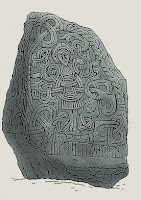
Why I studied this in an art class? Harold the Bluetooth, who also christianized the country, raised Jelling Stones which present the process of christianization. The stone has a figure of Christ on one side and on another side a serpent wrapped around a lion. Apparently, this stone is one of earliest marks of christian symbology. It is important as the early symbology had only 2 dimensions and afterwords it gained perspective and detailed descriptive narrations.
0


After the post about Transgenic Plants I couldn’t help but wonder how scientists (or transgenic "artists") can create such species. I took my last biology lesson 4 years ago in high school and I don't remember much about genes etc. So I did a little research about the subject.
While searching over internet, I figured that most of the pages were a little hard to understand for readers with non-biological backgrounds. Yet I found a document prepared by "European Initiative for Biology Education" (EIBE) and it was the simplest to understand. You can check it out by clicking here.
1) First scientists identify what is the gene of interest ( for example GFP gene found in the jellyfish that fluoresces green when exposed to blue light).
2) They form Recombinant DNA's. A recombinant DNA is, according to Wikipedia, a form of synthetic DNA thereby combining DNA sequences that would not normally occur together. So basically after identifying a gene that is responsible of a certain characteristic, they match the molecules of the chosen Gene with the normal DNA, so that the "Recombinant DNA" carries this foreign gene.
3) This is the step where they insert the transgene. According to EIBE, there are 3 methods that are used in this step; Microinjection, Use of Retroviral Factors and Embryonic Stem Cell Transfer.
Microinjection is maybe the simplest to understand. With this method the scientists inject the transgenes with a fine needle, inside of a fertilized cell while a microtube holding the fertilized cell.
The logic is the same as Mendel's discovery with peas (remember it from high school). In every method I suppose, they first inject the transgenic material and try to produce heterozygotes which are the result of a matching of one normal and one modified animal. If they manage to do so, then they match again two heterozygote animals to produce fully transgenic animals.
Here is a pic, when scientists implemented the growth gene to mice.

Although genetic experiments are realized mostly on mice, Taiwanese scientists created glowing pigs like the glowing rabbit Alba in 2006 according to BBC. There is even a video of the pigs on the site.
While I was searching all this stuff, a thought crossed to my mind. Think about transgenic humans. Today the genetic engineering has come to a point where a cactus with human hair or glowing rabbits could be easily achieved. So will genetic technology be used to create “better” human beings? Maybe one day secretly, modified humans with different abilities will exist (glowing in the dark wouldn’t be cool thoughJ ). And maybe we will be talking about a new genetically superior generation. Maybe there will be disputes within generations (Mutants vs. Normal People). I never thought these movies could refer to possible scenarios.
But with all these achievements in science, nothing really seems impossible, even Xman.


 Posts
Posts


