
Finally the semester is over. After all the finals to take, projects to finish, and reports to write I finally start enjoying some vacation for myself.
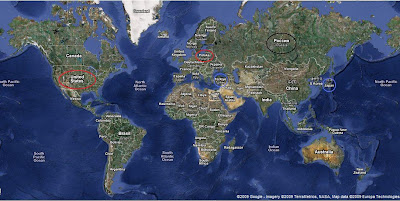
Here is our map:


New Year 2010!!!
It has almost been one year since I've been blogging( I have only written 10 posts or something!) and 2009 has been an important year for me.
The most importantly I am graduaded from university and got my industrial engineering degree. That's a major step I guess. After zillions of applications, I decided to go for a masters degree in industrial engineering also. So basically, I went from here

To there

With its magnificent view of the bosphorus and its great location, my old scool had a really nice small, warm feeling. Though it's better to change school after a while and observe the differences. I like my new university, although its very challenging, and I think that I've made a good choice.
With this new university, I started to stay on dorm first time in my life. I go to home at weekends and time passes tooooo quickly. Still, I guess I like that also.
In 2010, I plan to write more posts, share more and get the blog going. I am gonna make a list about my plans for the blog very soon.
Thoughts will be provided
in 2010
Happy new year!

Let's start…
He invented a musical instrument called glass armonica. Mozart wrote two pieces for the armonica, including "Adagio and Rondo 617," and in 1815, Beethoven wrote a short melodrama where a narrator told a story while accompanied by armonica.

He also invented an efficient stove providing more heat and less smoke than an ordinary open fireplace. His stove was described by his contemporaries as giving off twice the amount of heat as a normal fireplace for a third of the wood consumed.
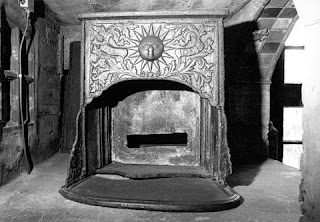
Along many many discoveries in electricity, he who invented lightning rod and saved millions of houses from thunder. Thanks to him, thunders were no longer disastrous.

The same guy was also the first one to observe Gulfstream currents.

These were only a couple of his inventions.
Who was it? Maybe this image would help.

It was Benjamin Franklin.
Benjamin Franklin (1703-1790) was born in Boston, as the youngest of 17 brothers. His father had a candle-shop, and his mother probably spent all her life with house work as a mother of 17 children.
His family was not wealthy or intellectual thus his family has never been a major factor of his success. Though, as I understand, they supported learning and to some extent Franklin's life choices.
He is sent to Latin school to learn theology at the age of eight. But he was not interested in it. His father Josiah, observes Benjamin's lack of motivation and takes him out of school. They afterwards search for a suitable job for 10 year old Ben.
As a child, he has a hunger for information of all kind and his father's library helps him a lot He spent many hours reading books from various kinds. He reads from Socrates to John Locke, at a very young age and continues reading all through his life.
Primarily, Ben works for a relative who repairs knife. He dislikes the job so with his father they search a more suitable job for him. Printing seems interesting for him, as it involves getting involved with books, so finally he starts as an apprentice in a printing shop. (He continues in this profession until he retires on age 42, in addition between many other professions he was given, he identifies himself as a printer on his will.)
After disagreements with the owner of the printing shop, he goes to New York in the hopes of a new job. Not finding in New York a printing shop to give him a job, he hears about some opportunities in Philadelphia. Therefore, he moves to Philadelphia for work.
In Philadelphia, he starts to write columns with fake names. Poor Richard's Almanac gains extensive popularity.
While spending many hours at work, he never neglects reading and more importantly thinking about everything. He forms a small discussion group, named Junto, where every Friday they discuss various topics. The topics may differ from public problems to scientific inventions, about everything that is helpful to discuss. Ben's Junto becomes so popular that other discussion groups are formed within the city.
Basically, as he continues to work in Printing( after a while as an owner of a printing house) he constantly thinks about the world around him, and this constant thinking and learning, helps him develop from very creative solutions to major public problems, to inventions in very challenging scientific areas.
He thinks, he researches, and he observes. Not on some major area, but basically in all areas.
He formed:
- the First Fire Department in Philadelphia
- City Cleaning System
- An Academy for poor children (Now became University of Pennsylvania)
- First Hospital in Philadelphia.
Namely a few.
He found a way to pass American Indian language to writing. Also he was the one who first used caricatures and question-answer technique in journalism.
He invented Glass Harmonica, a musical instrument composed of various sized glass cups.
He was the first to observe Gulfstream currents in the ocean, and thus proposed a better trajectory to pass the Atlantic.
Condenser, conductor, charge, discharge, battery, electrical choke, positive and negative electricity, plus – minus charges. These notions were introduced by him.
He discovered the difference between electricity and thunder. This discovery led to the invention of lightning rod. Thanks to him, millions of houses worldwide were protected from thunders.
I didn't even start to write about his role in politics and diplomatic achievements!!
- He was the first to propose the idea of union of states and a centralized government in 1751 (Albany Plan) His plan was not approved in the first time but after 20 years, his model gets acceptance.
- He represented colony in London for years
- He opposed to the Stamp act which was meant to burden excessive taxes upon colony
- He served as a delegate in Continental Congress and took place in the committee that prepared the draft of Deceleration of Independence.
- He seeks economic and military aid in France for America. With his efforts France assured critical military assistance to America. He also played a crucial role in bringing about the final peace treaty with Britain in 1783.
- After United States of America was founded, in 1785 at the age of 82, he gets elected as the President of the state of Pennsylvania.
He dies in 1790 at the age of 87.
I'm sure I forgot to mention some of his critical roles and contributions thus my intention was to give a brief resume of Benjamin Franklin.
I really can't understand how he could do all this, but he really did. I ask myself how it can be possible to succeed in so many different areas. Still, I guess the case of Benjamin Franklin motivates all to pass boundaries.
Think, Discuss, Observe. Maybe that was the key to his success. Never give up. Always learn other thinges.
Well, he was a great man, that's for sure!
Hopefully, this post is not a book review. It's about Cloud Computing.
Microsoft's Ceo, Steve Ballmer said that the company plans to spend 9.5 billion dollars in 2010, to cloud computing. The company will launch, Microsoft Azure, a cloud computing system.
Google has recently announced its Cloud-Based Operating System, Chrome OS and according to Google, the future is in Browsers and in the Cloud.
Amazon offers Cloud Based Storage, and according to their web site : "Amazon S3 provides a simple web services interface that can be used to store and retrieve any amount of data, at any time, from anywhere on the web."
Quite impressive huh? Given all that, I decided to search over what is this Cloud Computing? What is Software as a Service? Why is this important?

The first helpful document that I came across on the web, was UC Berkeley's 25 page report about Cloud Computing which summarizes what is cloud computing, its obstacles and how can these obstacles could be exceeded.
In simple words, Cloud computing is a general term for anything that involves delivering hosted services over the Internet. As the report suggests 3 aspects are new in cloud computing:
1. Infinite computing resources available on demand: thereby eliminating the need for Cloud Computing users to plan far ahead for provisioning.
Simply you have resources, and demands of using these resources. That means you can meet demands under resource capacity, but you cannot satisfy them if demand exceeds capacity.
Let's say, you have a website, and users login to the website. You run couple of servers in order to process the login information from users. Assuming, your servers can only process 1000 user login requests that means if more than 1000 users want to connect to site, you turn many down. (You wouldn't want that). On the other side, when user login requests are less than 1000, and you run servers that can meet up to 1000 users, that means you are running some servers unnecessarily (You wouldn't want that either).
Or, let's say the demand of users wanting to use the site varies a lot. Some days there are 1500 user demands, whereas the next days you have less than 1000. So you decide to rent/buy extra servers, that means you take a risk, if extra servers are not used that means you spent money unnecessarily.
So here comes the cloud solution, instead of owning servers/data centers, you deal with a (yours*100000...) sized Data center, and pay them for the resources you are using. As these big data centers( Cloud Providers) are well sufficient to meet any change in demand, there comes Infinite computing resources available on demand.
That gives you elasticity and lets you transfer that risk.
2. The elimination of an up-front commitment by Cloud users, thereby allowing companies to start small and increase hardware resources only when there is an increase in their needs.
This aspect of Cloud Computing would motivate business ventures, as the initial costs of the startup would decrease.
3. The ability to pay for use of computing resources on a short-term basis as needed (e.g., processors by the hour and storage by the day) and release them as needed, thereby rewarding conservation by letting machines and storage go when they are no longer useful.
For a business, if running servers on its own is more costly than paying per resource used on the cloud provider, then Cloud Computing is very useful.
According to Berkeley report, there are 10 major obstacles,
1. Availability of service
2. Data lock-in
3. Data confidentiality and auditability
4. Data transfer bottlenecks
5. Performance unpredictability
6. Scalable storage
7. Bugs in large distributed systems
8. Scaling quickly
9. Reputation fate sharing
10. Software licensing
Berkeley researchers, list possible approaches in overcoming these obstacles. And they say that:
"we believe that over the long run providers will successfully navigate these challenges and set an example for others to follow, perhaps by successfully exploiting the opportunities that correspond to those obstacles."
Also Mike Clein, president of Online Tech, states that
"For many, online data storage is less expensive, faster, more secure, and more reliable than the tape backup systems used over the past several decades. "
So, the future of Cloud Computing seems very bright. Go Cloud!
Einstein states in 1938, that:
“Humanity has every reason to place the proclaimers of high moral standards and values above the discoverers of objective truth. What humanity owes to personalities like Buddha, Moses, and Jesus ranks for me higher than all the achievements of the enquiring and constructive mind.”
Pretty strong, huh? I didn’t know that Einstein found religion more valuable than science. Apparently, Einstein has many statements supporting religion, but I thought that he would be kind of anti-religion as a very great scientist. This topic is very intriguing yet it is not the topic of this post. This post is about how I came across the quote above.
If you look at the (XX) posts published in this blog, you can easily realize that %90 of this blog is about Michael Crichton. I admit that I am a great fan of his work, but this time my adoration for him, multiplied. In Travels, only autobiographic book of Crichton, he tells the reader the milestones of his life, his challenging travels and what he gained from them.
When I came across this book at the university library, (I have previously tried to find it in bookstores but they don’t have it here) I got very excited. I realized that I haven’t really read an autobiographical or biographical book hence it was very different.
Why? I can explain this way, although I like reading classical thriller stuff, John Grisham, Dan Brown and of course Michael Crichton, as the characters are fictitious I get the idea that “these stuff wouldn’t happen in reality”. They are fun to read, but characters looked similar to me in every book.
One hero-type, one beautiful and smart woman, they get over the challenges together etc. After a while, I thought I had enough of these books for a while. So I read serious stuff like Guns & Germs and Steel, Fountainhead etc. Anyways, the idea of getting to know better such a creative mind, Travels seemed very exciting.

Travels starts by the medical studies of Crichton, why he studied medicine and why he didn’t practice the medicine. It is not common for one to get in to Harvard Medical School, struggle all along studies economically and mentally than after finishing the school never wanting to work as a doctor. He then continues with aspects of his life in Los Angeles, writing novels, and directing films. He progresses chronologically the important experiences of his life, thus his travels. He goes to roughly all the adventurous places in the world from Africa to New Zealand yet he shares what conclusions he reached after them.
The most interesting part, I think, is that the book is mostly about “inner travel”, the journey of one to his inner self. There are no such statements as “ Oh, dear Champs Elysées is really great, although I wanted escargot but the waitress got me wrong, Oh French people!” J I hope this is example I tried to give wasn’t cheesy, but I really want to emphasize the profoundness of this book.
Anyways, over time he is intrigued about psychic phenomenas like channeling, astral spaces, auras, energies etc. He experiences some of them, some of them not and he explains the details of his experiences. He experiences seeing auras and energies of people, talking to his dead father, and mediumship on some level. He is scientifically trained therefore his views on these matters are highly important. He is not someone who would accept anything without interrogating, but his experiences cited, represent something that cannot be explained, yet real. So should we accept them?
It’s a thought provoking question, of which I’ve never focused previously. I guess I always thought that some people had certain abilities (that KGB had focused on developing) but all this psychic stuff, kind of blah blah. Now I don’t know whether to believe or not. Before agreeing I need to see on my own. Thus I don’t deny them now.
Scientists generally find these unexplained events not true, fraud. One of the main reasons is that some of them are really frauds. Some practionners say that they are talking to dead, but they aren’t. Some say that they see your future, but they don’t see anything, etc. But that doesn’t mean that these phenomonas does not exist, according to Cricton. The same happens for science as well, he explains, Mendel fudged his data, Lazzarini faked an experiment to determine the value of Pi and so on. That does not mean that Science is fake.
After all, science does only answer “How Nature Works?” and not “Why nature works that way?” Humans have always searched for the meaning of their life, why do they exist. Science does not correspond to that answer and that’s why people are interested in psyche.
Probably that’s why Einstein said:
“Humanity has every reason to place the proclaimers of high moral standards and values above the discoverers of objective truth. What humanity owes to personalities like Buddha, Moses, and Jesus ranks for me higher than all the achievements of the enquiring and constructive mind.”
Crichton at the end of the book, summarizes his thoughts on this phenomenas, some of them he believes in, in some of them he does not, are to be taken seriously. He advises the reader not to take his word on this stuff, and go out for ourselves. If something does not work, try another. Be cautious of anyone seems interested in your money. Be cautious of someone who implies that he has the answer; the real answer is in you.

Thanks Michael Crichton.


 Posts


